Casa Grande Commercial Roofing FAQ
Casa Grande sits in the low desert between Phoenix and Tucson, where flat and low-slope roofs take long stretches of triple-digit sun, sudden summer storms, and blowing dust.
Questions About A Specific Building?
Distribution buildings near the I-10 and I-8 interchange, manufacturing plants, retail centers, and older downtown storefronts each put different demands on a roof membrane, its seams, and its drainage.
Casa Grande Commercial Roofing FAQ Topics
Jump to a topic in our Casa Grande commercial roofing FAQ, from roof systems to permits.
Roof Systems
Do you install TPO roofing on commercial buildings in Casa Grande?
Yes. We install, repair, and recoat TPO single-ply roofs on warehouses, retail strips, offices, and light industrial buildings around Casa Grande. See TPO roofing in Casa Grande.
White TPO reflects a large share of summer sunlight, which helps keep rooftop temperatures and cooling loads in check. Heat-welded seams resist the wind-driven rain that arrives with monsoon cells. On wide distribution roofs, we pay close attention to perimeter securement and to seams around curbs, since those details see the most stress.
Is EPDM a good choice for a flat roof in Pinal County heat?
It can be, especially on buildings that need a flexible, proven membrane at a moderate cost. EPDM tolerates movement from big day-to-night temperature swings without cracking. See EPDM flat roof installation and repair.
Standard black EPDM absorbs heat, so many owners here choose white-on-black EPDM or apply a reflective coating over it. Seam tape and flashings need regular checks, because years of UV exposure and dust abrasion wear on adhesives before the field membrane itself fails.
What does an industrial roofing contractor handle that a general roofer may not?
Industrial roofing covers large, complex roofs on plants, processing facilities, and logistics buildings, where rooftop equipment, exhaust, and safety rules shape every step of the job. See industrial roofing for plants and warehouses.
- Process exhaust and chemical exposure can call for a specific membrane or coating.
- Heavy foot traffic around HVAC and fans needs walkway pads and reinforced areas.
- Safety planning covers fall protection, lockout coordination, and limited roof access points.
- Phasing keeps production running while one section of roof is open at a time.
Can you install or restore metal roofs on commercial buildings near Casa Grande?
Yes. We work on standing-seam and exposed-fastener metal roofs found on shops, ag buildings, warehouses, and newer commercial construction across the area. See commercial metal roof restoration.
On older metal panels, the common problems are backed-out fasteners, worn washers, rust at laps, and failed sealant at ridges and penetrations. Many of these roofs can be restored with fastener replacement, seam sealing, and a reflective coating. Severely rusted or bent panels may need replacement.
Which roof system works best for my type of building?
The right system depends on roof slope, deck type, rooftop equipment, and how long you plan to own the building. A roof inspection narrows it down quickly.
| Building type | Systems that often fit | Why they suit Casa Grande conditions |
|---|---|---|
| Large distribution or logistics building | TPO, coating over existing single-ply | Reflective surface, fast installation on wide low-slope decks |
| Manufacturing or processing plant | TPO, EPDM, industrial-grade coatings | Handles rooftop equipment, exhaust, and phased work |
| Retail center or strip mall | TPO, EPDM | Clean details at parapets and many small penetrations |
| Metal shop, ag, or pre-engineered building | Metal restoration or new metal panels | Long service life; coatings add reflectivity |
| Older downtown masonry storefront | Single-ply or coating, matched to review rules | Low-slope roofs hidden behind parapets |
How long do TPO, EPDM, and metal roofs typically last here?
Service life depends on installation quality, membrane thickness, drainage, and maintenance, so these ranges are general expectations rather than promises.
| Roof system | Typical service life | What shortens it in the low desert |
|---|---|---|
| TPO | Roughly 20–30 years | UV exposure, foot traffic, poor seam welding |
| EPDM | Roughly 25–30 years | Seam adhesive aging, dark surface heat gain |
| Metal | Often 40+ years | Fastener and sealant failure, rust at laps |
A roof that holds water or never gets maintenance can fall well short of these figures.
Heat, Monsoon, And Cooling
How does desert heat affect a commercial roof in Casa Grande?
Sustained heat and intense UV are the main forces aging roofs here. They dry out sealants, embrittle older membranes, and break down coatings faster than in milder climates.
Large daily temperature swings make roofing materials expand in the afternoon and contract overnight. Over many seasons, that movement opens seams, loosens flashings, and cracks mastic around pipes and curbs. Reflective surfaces reduce peak surface temperatures and slow that wear.
When is monsoon season, and what should building owners check beforehand?
The National Weather Service defines Arizona's monsoon season as June 15 through September 30. Storms can bring strong outflow winds, dust, and short bursts of heavy rain.
Before mid-June, it pays to check:
- Drains and scuppers for dust, debris, and nesting material.
- Perimeter edge metal and coping for loose fasteners.
- Seams and flashings for open laps that wind-driven rain can reach.
- Rooftop units for missing panels or unsecured curbs.
After a strong storm, a quick look for ponding, displaced debris, and torn flashing catches damage before the next round of rain.
Do reflective roofs actually help with cooling costs in the desert?
They often help on buildings with large roof areas and a lot of air-conditioned space directly below. A bright, reflective surface stays cooler in the afternoon sun, which can reduce heat flowing into the building.
The effect varies with insulation levels, ceiling height, and how well the roof stays clean. Dust buildup dulls reflectivity over time, so periodic washing helps keep a white membrane or coating performing well.
Repairs And Upkeep
Should I repair or replace my commercial roof?
Repair usually makes sense when damage is limited and the insulation underneath stays dry. Replacement is the better path when leaks are widespread, the deck is compromised, or wet insulation runs across large areas.
Factors we weigh during an inspection:
- Age of the system against its expected life.
- Moisture in the insulation, found by core cuts or moisture survey.
- Leak history and whether past patches keep failing.
- Number of existing roof layers, since codes limit recovering.
- Plans for the building, including resale or a tenant change.
A roof in fair shape with a sound deck may also be a good candidate for restoration with a coating system, which can extend its life at a lower cost than tear-off.
What regular maintenance does a flat commercial roof need?
Most low-slope roofs here benefit from inspections twice a year, typically in spring before monsoon and in fall after it, plus a check after any major storm.
Routine work includes clearing drains, removing debris and dust buildup, resealing pitch pans and penetrations, checking seams and flashings, and confirming that service contractors have not left damage around HVAC units. Keeping simple records of each visit helps track problem areas over time.
Can roof work happen while my business stays open?
In most cases, yes. We plan roof work in sections so that stores, offices, and production lines keep running underneath.
- Early starts take advantage of cooler morning hours, which also helps adhesives and coatings cure properly.
- Staging areas are set away from customer entrances, loading docks, and fire lanes.
- Daily dry-ins close each open section before crews leave the roof.
- Advance notice goes to your team before noisy work, odor-producing work, or crane lifts.
- HVAC coordination keeps intake units away from fumes during application.
Permits, Taxes, And Incentives
Do I need a permit for commercial roof work in Casa Grande and nearby towns?
Often, yes. Reroofing and roof replacement on commercial buildings generally go through the local building authority, though the rules differ by jurisdiction and by the scope of the job. Always confirm with the office that covers the property.
Incorporated cities and towns run their own building departments. Unincorporated communities fall under Pinal County.
| Location | Status | Building authority |
|---|---|---|
| Casa Grande | Incorporated city | City of Casa Grande Planning & Development (plan review application) |
| Coolidge | Incorporated city | City of Coolidge building department |
| Eloy | Incorporated city | City of Eloy Building Official (Eloy building code) |
| Florence | Incorporated town | Town of Florence Community Development (department page) |
| Maricopa | Incorporated city | City of Maricopa Development Services, Building Safety (Building Safety) |
| Arizona City | Unincorporated | Pinal County Development Services, Building Safety (Building Safety) |
| Stanfield | Unincorporated | Pinal County Development Services, Building Safety (Building Safety) |
Buildings on tribal land follow that community's own rules, not city or county permitting, so check with the tribal authority for those sites.
Are there historic review rules for roofs in Casa Grande or Florence?
Yes, in both places, for properties inside designated historic districts or on landmark buildings.
- Casa Grande: The city requires a Certificate of No Effect or a Certificate of Appropriateness before exterior alterations to a designated landmark or a building in a historic district. Its application packet treats a change in roofing material as an alteration. Minor work goes to the Planning Department; larger changes go to the Historic Preservation Commission. Ordinary repair and maintenance are treated differently, so confirm where your project falls (application packet).
- Florence: The town's Historic District Advisory Commission reviews development inside the historic district boundaries, and its design guidelines include sections on roofs and roof materials (HDAC agenda packet).
Many historic storefronts have low-slope roofs hidden behind parapets, so the visible elements, such as parapet caps, awnings, and any pitched sections, tend to draw the most attention.
Can a new commercial roof be written off under Section 179?
Possibly. IRS rules let businesses elect to expense certain improvements to nonresidential real property, and roofs are on that list when the work happens after the building was first placed in service.
Key points from IRS Publication 946:
- Annual cap: for tax years beginning in 2026, the maximum Section 179 deduction is $2,560,000, and it phases down once qualifying purchases pass $4,090,000.
- Building type: the roof must sit on an existing nonresidential building such as a warehouse, plant, store, or office.
- Residential rentals: apartment and other residential rental buildings do not qualify for this treatment.
- Business use: the property has to be used in an active trade or business.
Tax situations vary, so review timing and eligibility with your CPA before the work begins.
Are there utility incentives for reflective or cool roofs near Casa Grande?
Sometimes. Depending on the property's location, electric service in the area may come from APS, SRP, or a local electrical district, and each sets its own business energy programs.
Programs open, close, and change terms often, so we never count on a rebate when recommending a roof. Where a program does exist, it commonly requires a product with a rating from the Cool Roof Rating Council, along with pre-approval before installation. Check directly with your utility before the project starts.
Areas And Getting Started
What areas do you serve?
We serve commercial and industrial properties in Casa Grande and the surrounding Pinal County communities:
How do I get started with a commercial roof project?
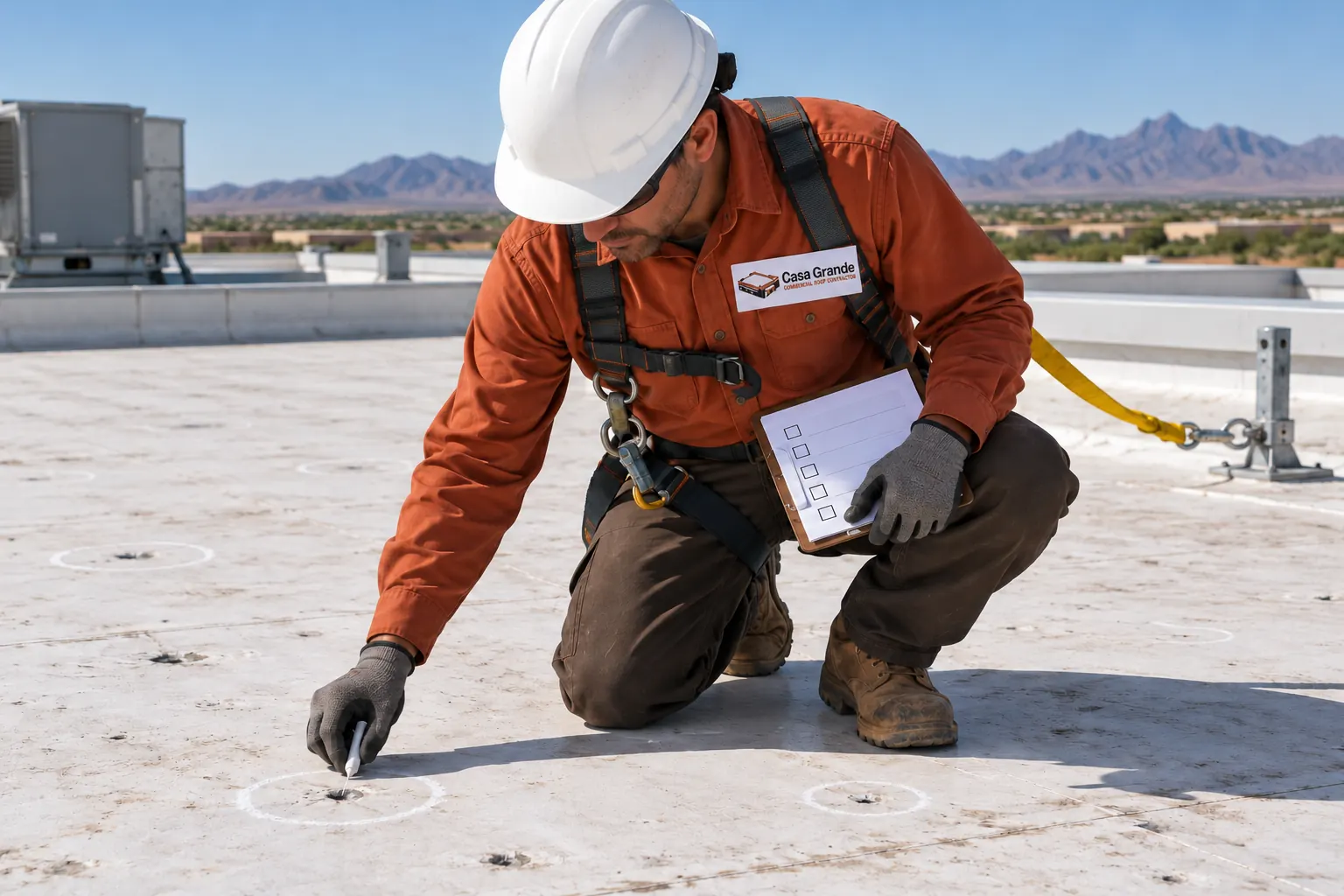
Call us or request a free estimate to set up a commercial roof inspection. It gives you a clear picture of the roof's condition before any decision on repair, restoration, or replacement.
During the inspection, we check:
- Membrane or panel condition, including UV wear, cracking, blisters, and rust.
- Seams, laps, and flashings at walls, curbs, and penetrations.
- Drainage through drains, scuppers, gutters, and any ponding areas.
- Moisture in insulation, where conditions call for it.
- Edge metal and rooftop equipment for loose or damaged components.
- Deck soundness where it can be observed or tested.
You receive photos and a plain-language summary of what we found and the options that fit the building.
Sources
- IRS Publication 946, How To Depreciate Property
- City of Casa Grande, Standard Plan Review Application
- City of Casa Grande, Certificate of No Effect / Appropriateness packet
- City of Eloy, Building Code Administration
- Town of Florence, Community Development
- Town of Florence, Historic District Advisory Commission agenda packet
- City of Maricopa, Building Safety
- Pinal County Development Services
- Pinal County Building Safety
- Cool Roof Rating Council, Rated Products Directory
Still Have A Roof Question?
Call with what you see on the roof or inside the building, or request a free estimate and we will set up an inspection.