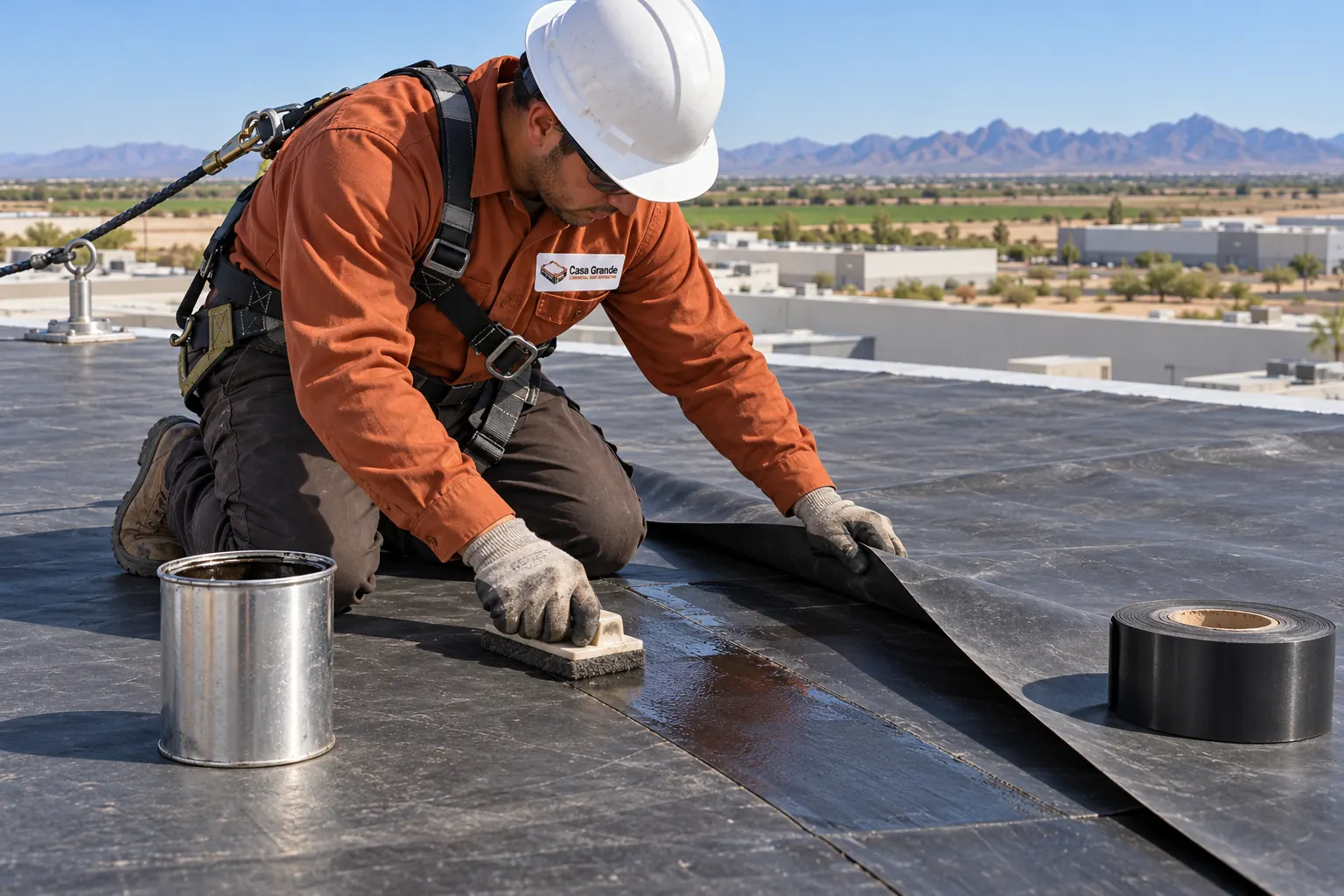
EPDM Roofing Contractor
Roofs crowded with pipes and vents often go EPDM, since its taped laps and stretch handle movement around many small penetrations.
EPDM flat roof installation and repair
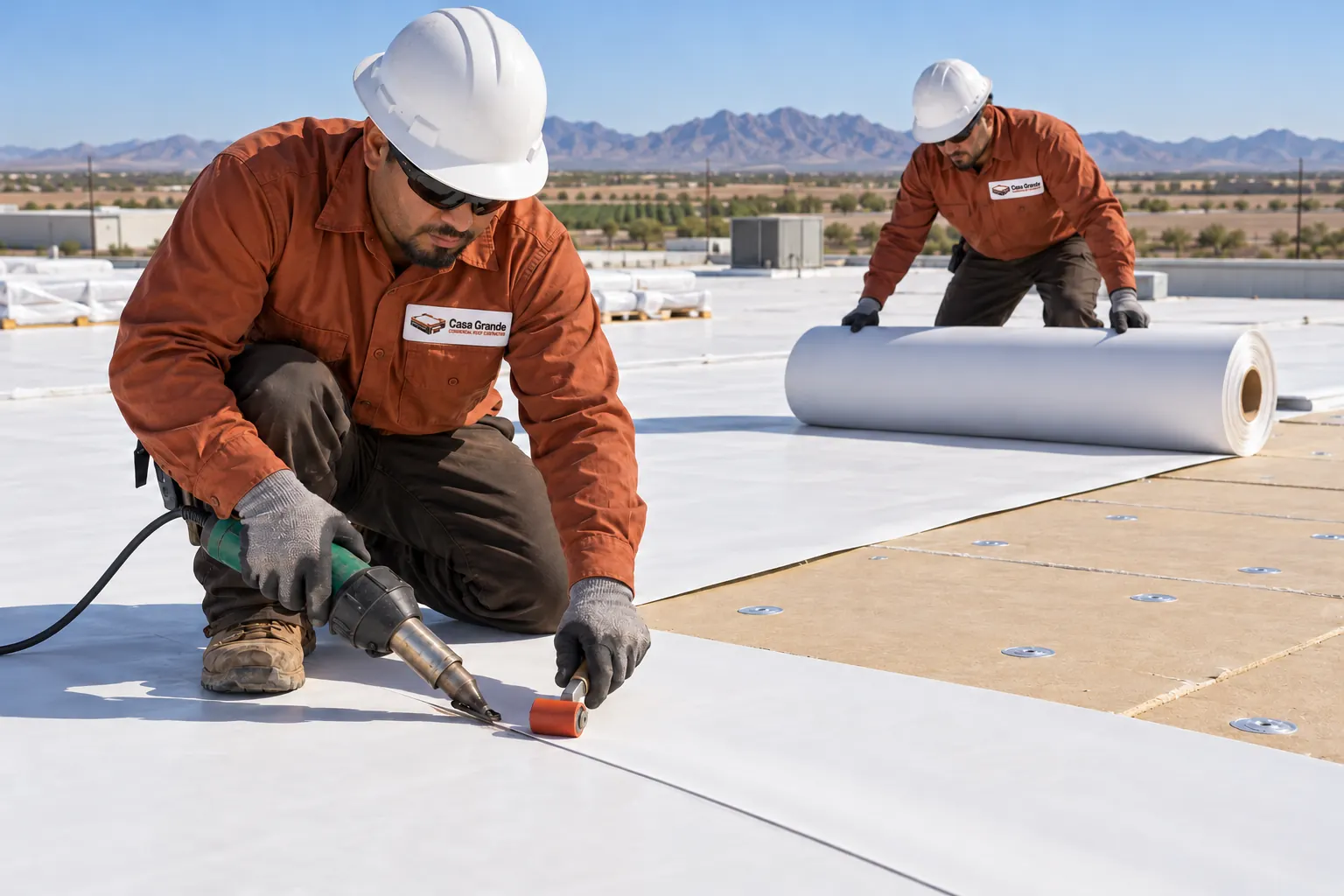
We are a TPO roofing contractor in Casa Grande, installing and repairing heat-welded white membrane on warehouses, retail centers, and offices, from tear-off to the last flashed curb.
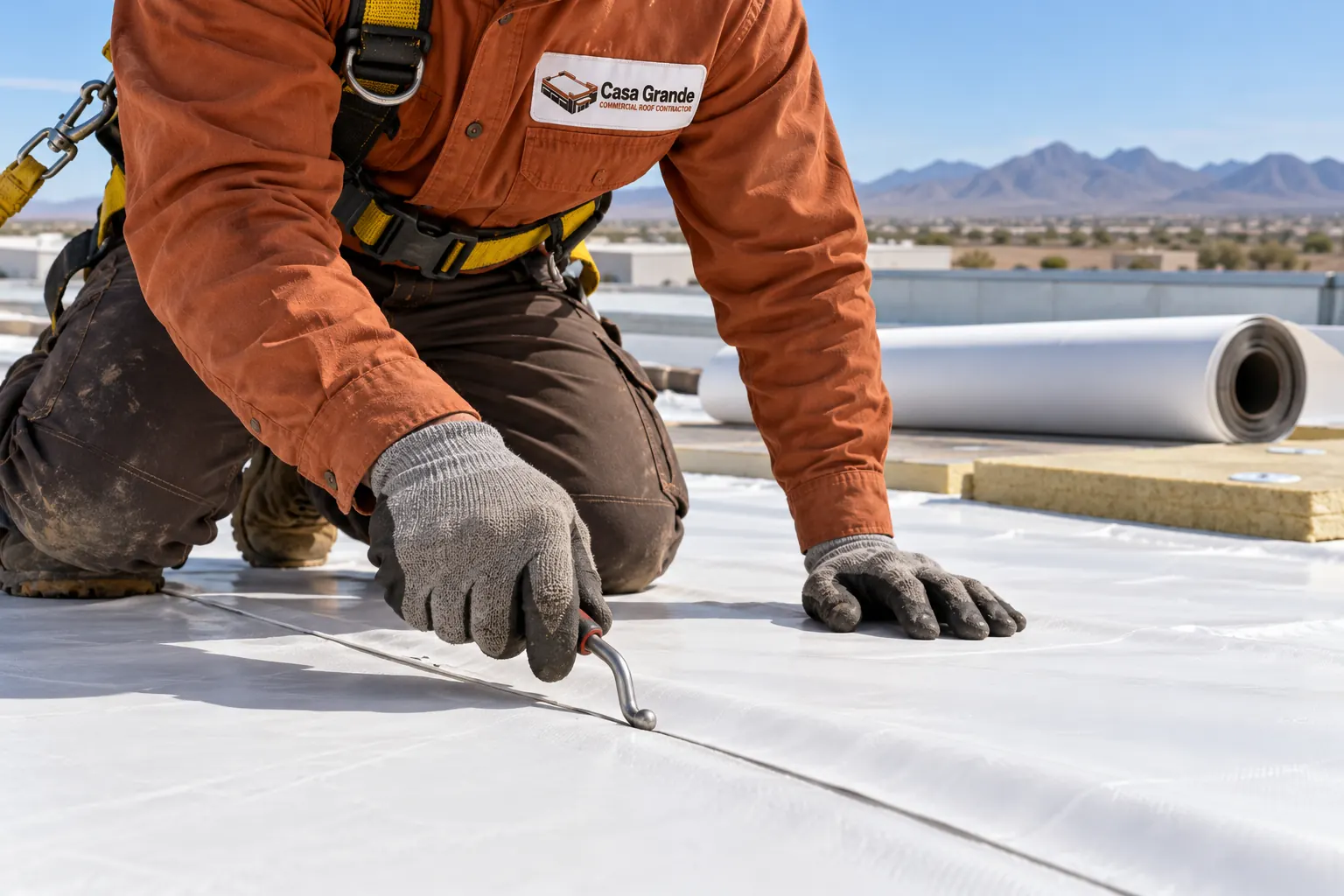
Heat-welded laps, probed by hand
White surface for hot afternoons
Core cuts decide recover or tear-off
TPO does its best work on low-slope roofs that drain. These are the signs we look for on each side.
These pairs show what a failing TPO roof looks like from the floor and from the deck above.
Stains form in a straight line across several ceiling tiles, following the direction the roof sheets run.
Unwelded Or Peeled Lap: A probe slides into the lap where the weld never fused or heat cycling peeled it, often near a curb corner.
Water appears near a rooftop unit soon after an HVAC visit, sometimes around a new condensate line.
Punctures Along Service Routes: Dropped screws and tools leave small holes in the membrane between the hatch and the units.
Staff hear a flapping sound on windy afternoons near the building edge or above the dock doors.
Loose Perimeter Securement: Membrane at the edge has lost fasteners or bar, so outflow gusts lift it and break the seal at the coping.
Odor or mold spots show up away from the walls, under the low areas of the roof.
Ponding Around Drains: Water sits for days at a sunken drain sump or in a deck valley, softening the insulation below.
Afternoon temperatures in top-floor rooms creep up, and the AC runs longer than it did a few summers ago.
Dust-Dulled White Surface: Blowing dust settles on the membrane and dulls its reflectivity, so the roof absorbs more afternoon heat.
Most TPO jobs fall into one of four scopes. Core cuts and a deck check decide which one your roof needs.
| Scope | When it fits | What it involves |
|---|---|---|
| Seam and flashing repair | Leaks trace to a few laps, curbs, or penetrations on a roof with life left | Cleaning, probing, and re-welding laps, plus new flashing at failed curbs |
| Recover over the old roof | One existing layer, dry insulation, and a solid deck | Cover board or insulation, new TPO fastened through to the deck, and new edge metal |
| Tear-off and replace | Wet insulation over large areas, two existing layers, or deck damage | Removal to the deck, deck repairs, new insulation, and new membrane |
| Tapered insulation upgrade | Water stands near drains or in valleys after storms | Sloped boards and crickets that move water to drains before the TPO goes on |
Four results to expect from TPO installed over a dry, sloped assembly.
White TPO reflects a large share of summer sunlight, which helps keep rooftop temperatures and cooling loads in check.
Hot-air welds join each lap into one sheet, so wind-driven monsoon rain has no adhesive edge to work under.
Edge metal and perimeter rows get extra securement, since the roof edge takes the hardest gusts on wide buildings.
Small punctures on a clean TPO roof take a welded patch, which holds better than mastic smeared over the surface.
Call and describe the unit or pipe where the leak shows. Seams at curbs see the most stress on wide TPO roofs, so we check them first.
Every TPO roof we install follows these five steps, from the first core cut to the final probe of the welds.
Each lap near curbs and edges gets probed, and core cuts tell us whether the insulation under the existing roof is dry enough to recover.
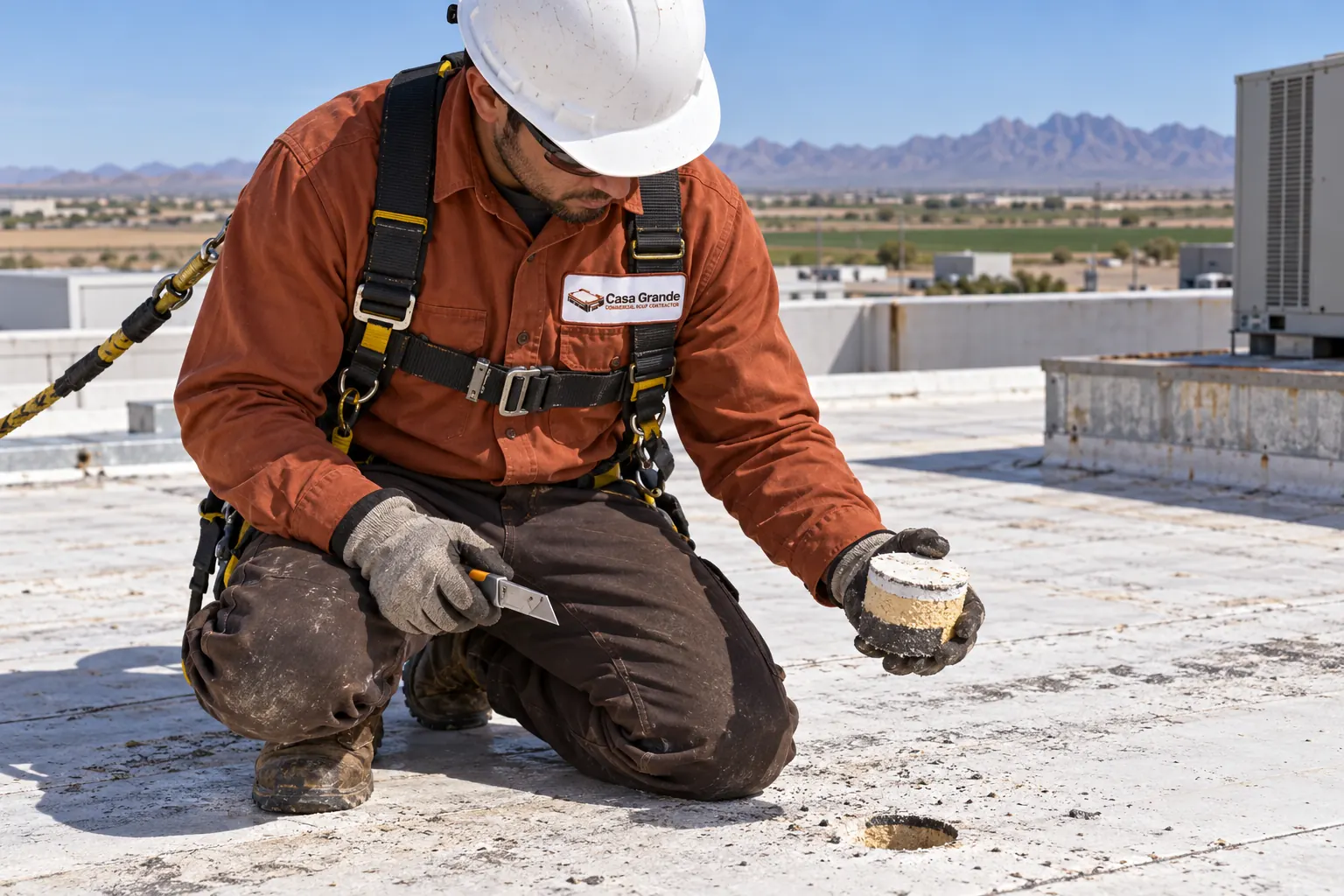
Repair, recover, or tear-off is chosen from those cores, and the summary shows which areas need tapered insulation before membrane goes down.
Wet boards come out, rusted deck spots get fixed, and new insulation or cover board is fastened in tighter rows at the edges and corners.
Sheets roll out and every lap is hot-air welded, with walkway pads added along routes to the units and the roof hatch.
A probe runs along every weld before the crew leaves, and the final walk with you covers curbs, drains, and edge metal.
Some buildings fit another system better. These two come up most often next to TPO.
Roofs crowded with pipes and vents often go EPDM, since its taped laps and stretch handle movement around many small penetrations.
EPDM flat roof installation and repair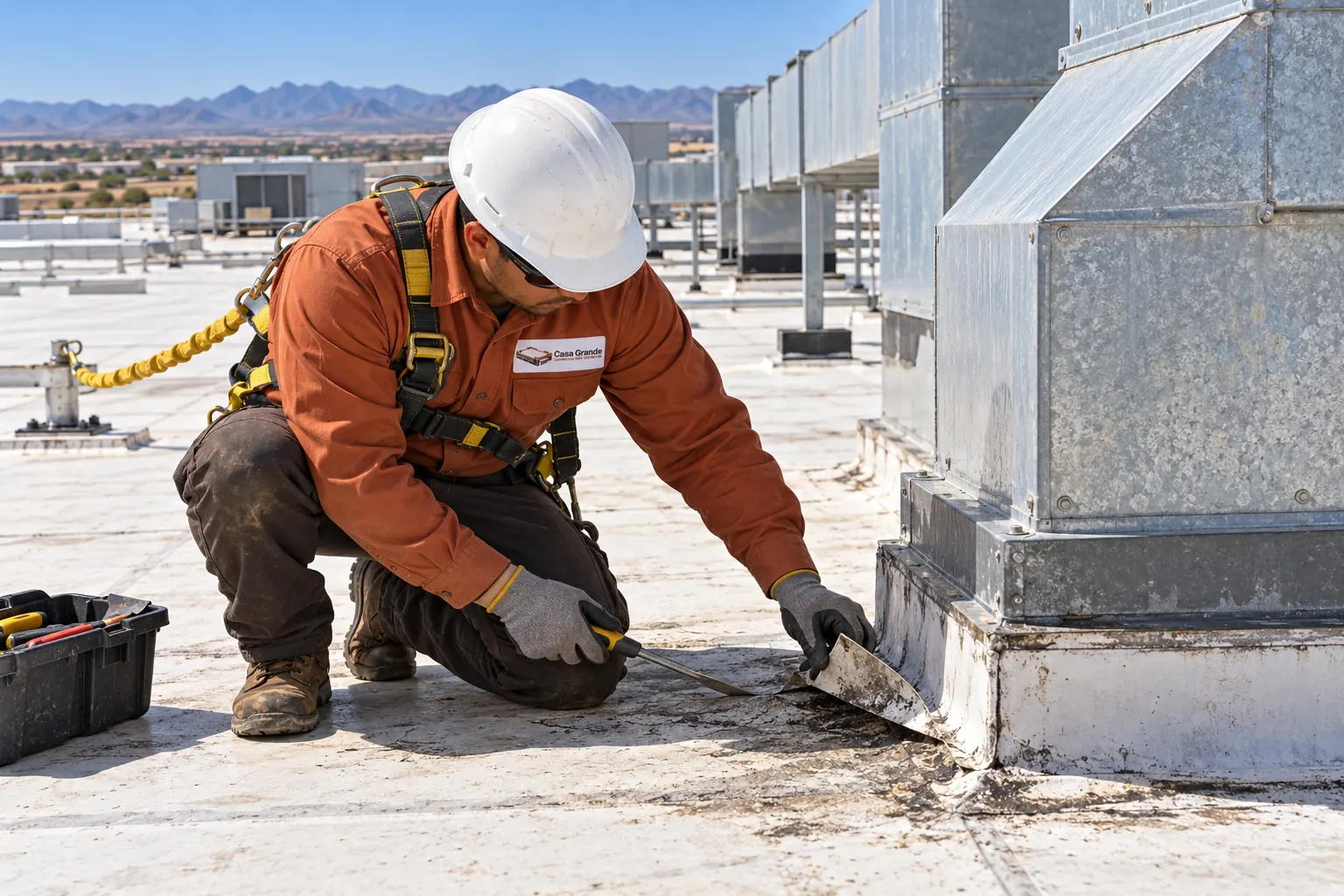
Plant roofs with exhaust stacks and daily foot traffic need phased work and reinforced walk paths around the equipment.
industrial roofing for plants and warehousesAnswers about installing, repairing, and maintaining TPO in Casa Grande.
Yes. We install new TPO, repair it, and recoat older TPO on warehouses, retail strips, offices, and light industrial buildings. On wide distribution roofs, perimeter securement and the seams around curbs get the closest attention, because those details carry the most stress.
Thickness is a spec choice. Common commercial sheets come in 45, 60, and 80 mil, and a thicker sheet adds weathering margin and puncture resistance on roofs with heavy service traffic. We recommend a thickness based on traffic, exposure, and how long you plan to keep the building.
Often, once the gravel is removed and the surface is solid. A cover board goes down first so the new membrane has a smooth base. If core cuts show wet insulation or a second layer below, the old roof comes off instead.
Dust. Blowing dust settles on the membrane and dulls the white surface, which lowers how much sunlight it reflects. A periodic wash with a mild cleaner brings back much of the brightness, and we can show your maintenance crew what to use.
A probe tells you. Running a blunt seam probe along each lap finds spots where the weld never fused or has started to peel. We probe every weld at installation and on maintenance visits, then re-weld any opening we find.
It holds up to routine service visits, but repeated traffic wears it. Walkway pads welded along the routes to each unit, fan, and hatch take that wear instead of the membrane, and they show techs where to walk.
Roof size, tear-off versus recover, the amount of wet insulation, tapered insulation for drainage, membrane thickness, and the number of curbs and penetrations. Access for lifts and dumpsters matters too, and the inspection pins these down before you get a price.
Share the roof size and where leaks show inside. We inspect, probe the seams, and give you a summary with photos first.
Leave a name and number and we will call you back.
Or call now: +1 (623) 310-0221